Promotional Sales Platform
Powerful Ticket Packaging and Plans
Ticket packaging doesn't have to be hard

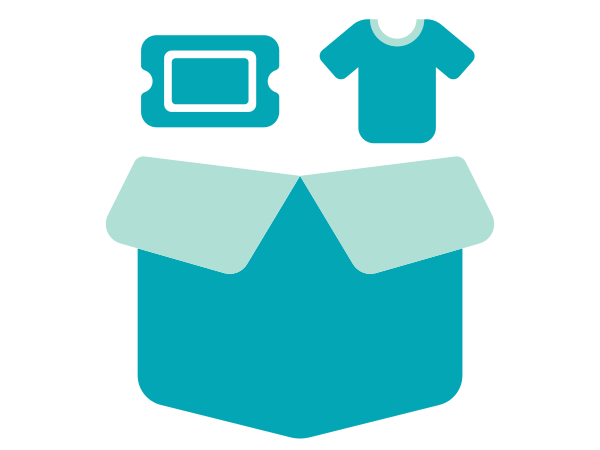
Spinzo can bundle numerous tickets into "packages" (e.g., family-four pack). It also has numerous capabilities to bundle in additional components using its "accompanying item" technology. This allows for one-to-one, one-to-many, or many-to-one inclusion of other items in a ticket package.
One-to-one example:
If tickets come with a t-shirt, you can instruct Spinzo to sell an accompanying item into your ticketing system (which happens simultaneously to the ticket order). If a buyer purchases 3 of these packages, they get 3 ticket barcodes and 3 t-shirts barcodes.
One-to-many example:
You could sell a flex package in Spinzo worth a certain number of event credits. One package comes with 5 credits. If the buyer purchases 1 of these packages, they get 5 credits.
Many-to-one example:
You could add parking as an incentive but only place 1 parking pass on the account for every 4 tickets purchased (e.g., one parking for each family 4 pack sold).
Automatic second-property tickets as a bonus

Many Spinzo clients use the "Accompanying Item" technology to give bonus tickets to another property during the transaction. For example, you can run a promotion for for your major league sports team property, but each ticket sold includes a ticket with the minor league affiliate. The bonus tickets for the second property don't have to be in the same seating zone. They can be for any other price code or hold class. In fact, you can even secretly split the revenue between the two events however you'd like. For example, if the ticket (which includes the minor league bonus ticket) cost $50, you can instruct Spinzo to push in $40 for the main ticket and $10 for the secondary ticket.
Payment splits for packaged gifts

In all packaging scenarios for Spinzo, you have the option to create custom money splits, across the items. For example, in a ticket + t-shirt example, the buyer could pay $50, but in your ticketing system, Spinzo is secretly pushing it in as $45 for the ticket and $5 for the t-shirt. Let's say Verizon sponsors a hat too, you can then add a hat as an accompanying item, and pay it with $7 but have that money paid off by a different method of payment (VZ – Verizon). Now you'd have $57 flowing into the ticketing system: $45 from Spinzo for the ticket, $5 from Spinzo for the t-shirt, (totaling $50 coming from Spinzo), and $7 as a receivable from Verizon for the hat.
Offer unlimited optional add-ons
Paid add-ons can be added to offers at various levels of the Spinzo hierarchy. You can add merchandise or parking for all buyers for a particular group outing, or buyers of only a specific type of seating zone. For example, you can offer the ability to add parking only for buyers who purchase VIP seating. Add-ons can have titles, descriptions, links, images, and limits. They can also be pushed into the ticketing system and barcoded if desired.
The all-powerful Spinzo flex plan

Spinzo has end-to-end flex-plan functionality. A flex plan can be "multi-event" or "ticket bank". In both cases, the buyer purchases the plan and instantly receives an auto-generated personalized code and link that they can use to redeem their games, immediately or at their leisure in the future. There's no need to choose the events at the time of initial purchase. Upon redemption of a specific event or tickets, buyers can be offered upgraded seating zones for an additional price. They can also purchase additional seats for a particular event. Finally, if the flex plan includes only certain events (non-premium), you can offer an upgrade to a premium event. The Spinzo platform keeps track of tickets (or events) remaining on a code, and this is presented to the buyer upon each redemption.
If you prefer to sell a simple non-flex plan that you have created in your primary ticketing system, Spinzo can do that too!